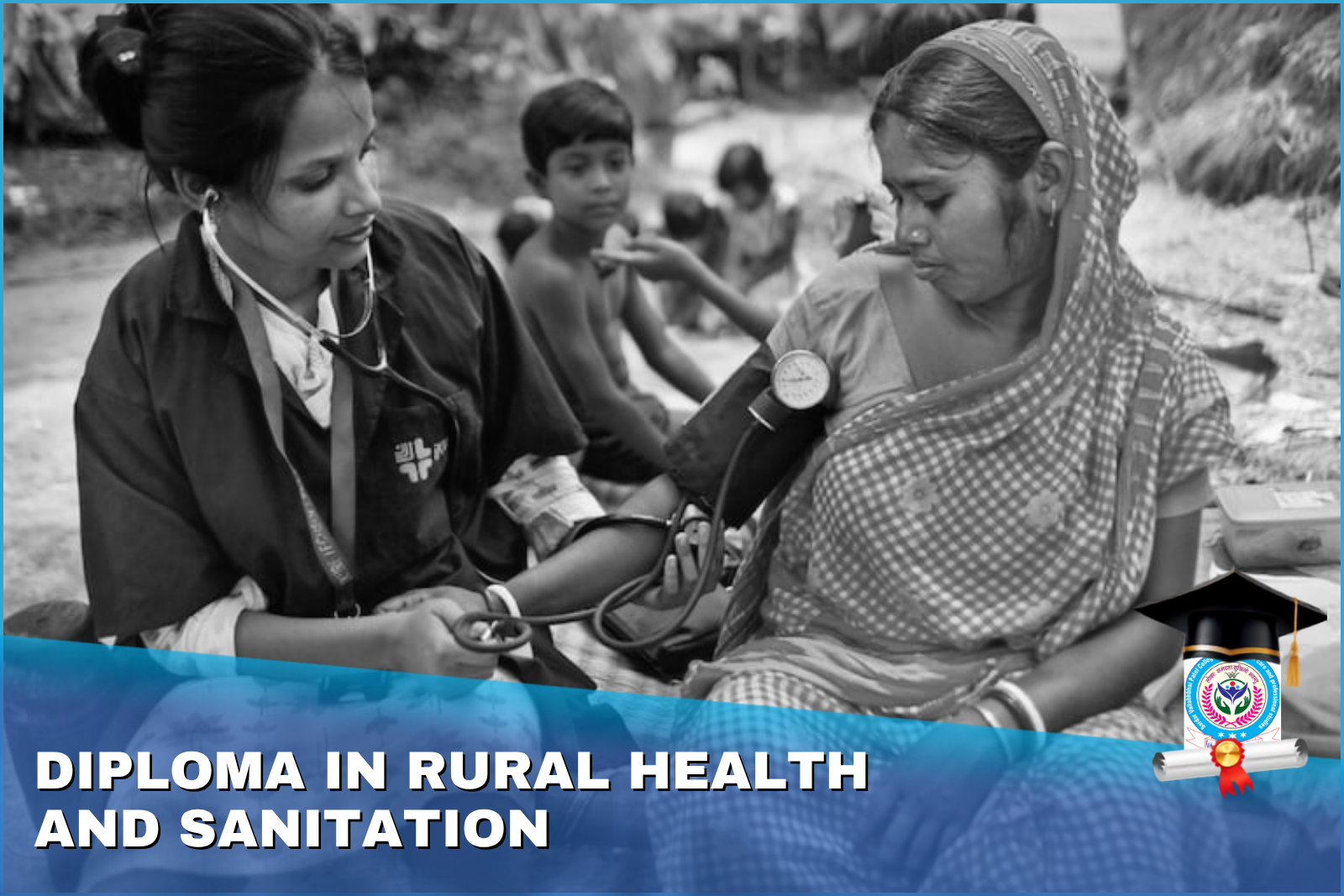
The Diploma in Rural Health and Sanitation is a specialized paramedical and public health program designed to train professionals in community healthcare, waste management, disease prevention, and hygiene practices in rural and semi-urban settings.
It focuses on improving living standards, preventing epidemic outbreaks (like cholera, malaria, and typhoid), managing solid/liquid waste, and delivering primary healthcare awareness directly to rural communities. Graduates typically work as Health & Sanitary Inspectors, Rural Health Coordinators, or Community Health Workers with municipal corporations, government health departments, and non-governmental organizations (NGOs).
Standard Program:1 Year (Divided into 2 Semesters)
Extended/Advanced Diploma Options:1 to 2 Years (depending on the specific university or technical board)
Internal Assessment (25% – 30% Weightage):
Mid-term written tests / unit assessments
Practical record books and sanitation survey reports
Class attendance and active participation
External Theory Examinations (70% – 75% Weightage):
Semester-end written papers covering core subjects like Public Health, Hygiene, Microbiology, and Environmental Engineering.
Practical & Field Training:
Practical Exam & Viva-Voce: Water quality testing, vector control techniques, and first-aid demonstrations.
Field Project / Internship: Mandatory field attachment with rural health centers (PHCs), municipal waste treatment units, or community sanitation initiatives.
Semester 1: Core Fundamentals & Hygiene
Public Health & Environmental Sanitation: Principles of personal and environmental hygiene, housing standards, and ventilation.
Basic Human Anatomy & Physiology: Basic understanding of human body systems and common illnesses.
Microbiology & Parasitology: Introduction to disease-causing bacteria, viruses, and parasites.
Water & Air Sanitation: Water sources, purification techniques, water sampling, and air pollution control.
Semester 2: Community Health, Waste & Disease Control